Energy Storage News
Ministry Of Finance Approved a ₹5,500 Crore Floating Solar Battery Storage Plan
On this page
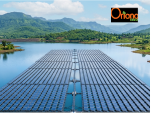
India has taken one of its boldest steps yet in clean energy.
The Finance Ministry's Expenditure Finance Committee (EFC) has officially approved a ₹5,500 crore scheme to develop floating solar battery storage projects across the country. The proposal will now head to the Union Cabinet for final clearance and when it gets the nod, it will reshape how India generates and stores solar power.
This isn't just a policy announcement. It's a signal that India is doubling down on renewable energy like never before on water.
What Exactly Is Floating Solar Battery Storage?
Floating solar battery storage refers to solar panels installed on the surface of water bodies reservoirs, lakes, irrigation ponds paired with battery energy storage systems (BESS) that save excess power for use during peak demand or night-time hours. Think of it as solar power, but smarter and more space-efficient.
Why Water Bodies Instead of Land?
India faces a real challenge land is expensive, contested, and limited. Water bodies offer a practical alternative:
A. Solar panels stay cooler on water, boosting energy output by up to 10–15%
B. No farmland, forest, or residential land is disturbed
C. Evaporation from reservoirs is reduced, conserving water
D. Existing dam and reservoir infrastructure can be leveraged
When battery storage is added to the mix, the system doesn't just generate power it stores and delivers it reliably, solving the biggest complaint about solar: it only works when the sun shines.
Breaking Down the ₹5,500 Crore Scheme:
The Expenditure Finance Committee (EFC) under the Finance Ministry approved the scheme in May 2026
The Ministry of New and Renewable Energy (MNRE) had originally requested ₹6,700 crore the EFC trimmed it to ₹5,500 crore and asked for revisions to the incentive structure
Floating solar installations will be developed on reservoirs and water bodies integrated with battery storage
The scheme will now go to the Union Cabinet for final approval
MNRE Secretary Santosh Sarangi has spoken of exploring new incentive mechanisms for a more geographically balanced rollout of renewable projects
Why Is the Government Moving So Fast on This?
Two words: energy security. Global geopolitical tensions particularly the ongoing instability in West Asia have sent shockwaves through fossil fuel supply chains. India imports a significant chunk of its energy needs. That dependence has become a liability.
Floating solar battery storage addresses this directly:
A. It reduces reliance on imported coal, oil, and gas
B. Battery storage reduces grid stress during demand peaks
C. It helps India meet its ambitious renewable energy targets
D. It diversifies where and how solar is deployed beyond traditional high-radiation zones
Officials have made it clear: this scheme is part of India's larger clean energy transition roadmap, designed to bulletproof the country's energy supply from volatile global markets.
Pilot floating solar projects in Madhya Pradesh and Andhra Pradesh have already demonstrated that this technology is both scalable and viable at the ground level. These early-stage projects have built confidence among policymakers that floating solar battery storage can be rolled out nationwide.
How Much Untapped Potential Does India Have?
According to MNRE data, India has installed less than 1 GW of floating solar capacity so far. That number is expected to grow significantly as states and project developers are being actively encouraged to identify suitable water bodies for floating solar PV (FSPV) projects.
This scheme is more than a financial outlay it's a statement about where Indian solar is heading.
States will be incentivised to actively identify and develop floating solar sites
Battery energy storage systems will become a standard part of renewable project design
Grid reliability will improve as storage capacity grows alongside generation
The scheme signals a push beyond the sun-belt states into regions with less solar radiation but abundant water bodies
For developers, investors, and the solar industry, this is a significant policy tailwind.
Key Takeaways at a Glance
A. EFC has approved ₹5,500 crore for floating solar battery storage Union Cabinet approval is pending
B. Projects will be built on reservoirs and water bodies, easing land pressure
C. Battery storage integration will improve grid stability and energy reliability
D. MNRE originally sought ₹6,700 crore; EFC approved a revised, leaner outlay
E. Pilot projects in MP and Andhra Pradesh have already validated the model
F. India currently has under 1 GW of floating solar the growth runway is massive
FAQs
Q1. What is the ₹5,500 crore floating solar battery storage scheme?
It's a government-approved plan to build floating solar panels on water bodies across India, paired with battery storage systems to ensure reliable power supply. Final Union Cabinet approval is pending.
Q2. Why install solar panels on water instead of land?
Land in India is scarce and costly. Water bodies are underutilised, panels stay cooler on water boosting efficiency, and no farmland or forest is disturbed.
Q3. Which states have already piloted floating solar in India?
Madhya Pradesh and Andhra Pradesh have successfully run pilot floating solar projects, proving the technology works at scale.
Q4. How much floating solar capacity does India have right now?
Less than 1 GW making it a largely untapped segment with massive growth potential under the new scheme.
Q5. How does this scheme strengthen India's energy security?
It reduces dependence on imported fossil fuels. Battery storage saves surplus solar energy for high-demand periods, stabilising the grid and cutting vulnerability to global energy price shocks.